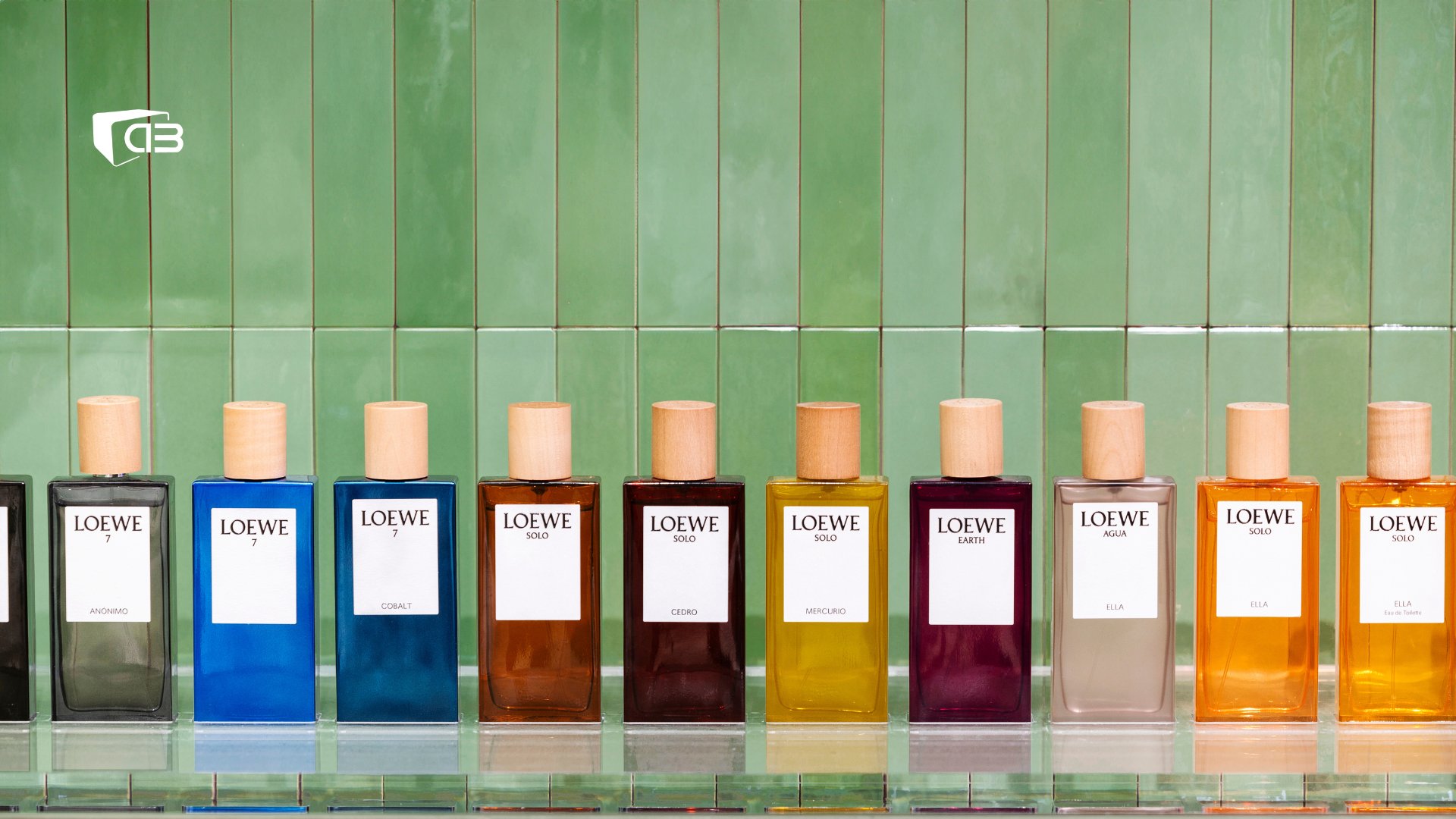
In today’s luxury retail landscape, the commercial space has become a direct extension of the brand. Retail furniture no longer serves a purely display function: it defines experience, perception, and positioning. That is why the approach taken to manufacturing commercial furniture has a decisive influence on the final outcome of every project.
When design and production are part of the same system, the development of bespoke commercial furniture takes on a different dimension. In-house manufacturing becomes a strategic element that allows every technical decision to engage with creative intent from the outset, preventing the process from fragmenting into disconnected phases.
At Aluma3, we understand in-house production as an essential part of an integrated retail project. It is not an isolated stage within the design and manufacturing of commercial spaces: it is the structure that supports the entire process and ensures that the original concept is realized with coherence, precision, and continuity.
In-House Manufacturing: Where Design and Production Work as One Team
In-house manufacturing at Aluma3 is not conceived as an independent unit within the process, but as the operational core that articulates every project. With more than 6,000 m² of dedicated production facilities, we work within a single technical framework from the first brief through to final delivery.
In retail furniture, this integration transforms project dynamics. Production does not act as a phase that follows design: it is a natural extension of it. Technical and creative teams work on a shared foundation, validating structural solutions, refining details, and anticipating constraints before moving to subsequent phases.
The Aluma3 workshops produce, among other things:
- Custom commercial furniture
- Technical and decorative display units
- Functional elements adapted to spatial flow
- Purpose-built construction solutions for retail, showroom, and exhibition spaces
Beyond the specific typology, what matters is the method applied to every piece. All elements are developed from technical specifications defined in the design phase, which allows the team to:
- Adjust tolerances to millimeter precision
- Validate materials prior to serial production
- Analyze resistance and behavior in test environments
- Evaluate how each material interacts within the overall composition
Integrating manufacturing within the operational structure also reduces the fragmentation typical of projects involving multiple suppliers. Communication between design and production is direct, schedules are adjusted with greater precision, and decisions can be made without depending on external intermediaries. This makes it possible to anticipate potential adjustments, minimize deviations, and provide a more realistic view of execution timelines.
Success Story: Guerlain – Overnight Installation to Transform an Airport Space
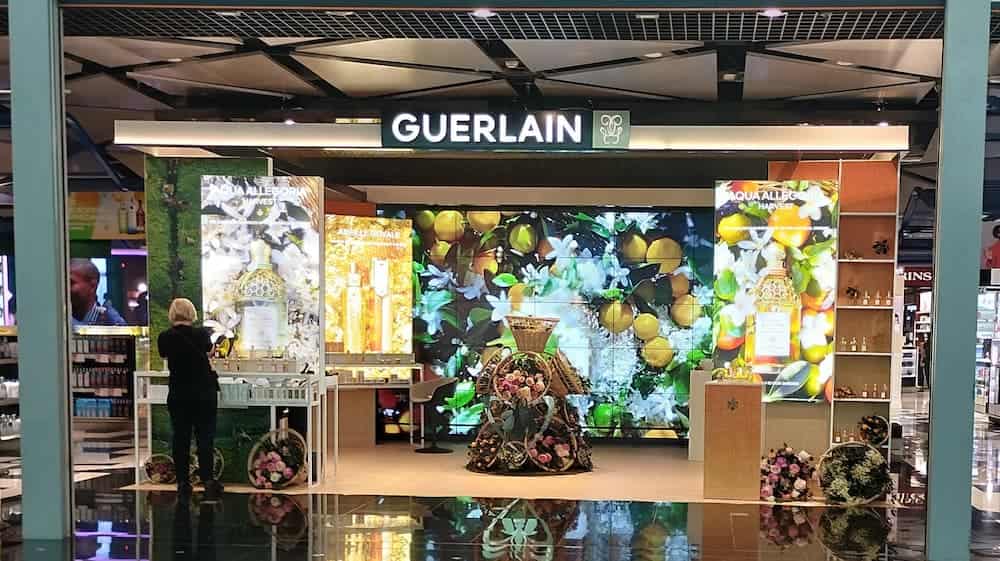
For the Guerlain pop-up store in the Duty Free area of Barcelona Airport, the project had to be executed in a continuously operating environment under strict security conditions. The structure was designed from the outset with agile installation in mind, allowing the floor and structural assembly to be completed within six hours, in a single overnight window, following the dismantling of the previous promotion and leaving the space ready for activation.
Close coordination between the technical office and the installation team, combined with precise planning from the manufacturing phase, made it possible to meet the schedule without compromising the final result.
In retail furniture projects where openings or installations are subject to tight deadlines, this predictability makes a real difference. It is not simply about meeting timelines: it is about working with greater confidence and less uncertainty at the critical stages of the project.
Customization Without Catalogues or Limits: Precision, Materials, and Finish
In-house manufacturing expands the project’s customization capacity from its structural foundation, becoming a strategic tool for preserving brand essence in the physical space.
Every element of commercial furniture contributes to building a tangible identity: proportions, materials, finishes, and technical solutions all form part of the narrative the customer experiences as they move through the point of sale.
By removing the constraints imposed by standard catalogues, bespoke commercial furniture can be developed from scratch, without creativity being conditioned by closed solutions. The ability to make adjustments during development, prototype, and validate solutions before final production reinforces coherence between concept and execution.
In-house manufacturing also enables strategic material selection based on actual behavior within the overall composition. It is possible to choose between technical or natural woods, structural or decorative metals, compact surfaces or recyclable materials, based on intended use, traffic intensity, or the environmental conditions of the space.
The direct impact of this control is reflected in the final quality. Internal manufacturing allows quality standards to be supervised directly and continuously:
- Finish control before each piece leaves the workshop
- Structural verification of every element
- Homogeneity across every touchpoint of the project
Quality is not added at the end of the process. It is built from the beginning and validated at every stage. The result is furniture that remains faithful to the original concept without compromising technical precision or attention to detail.
Success Story: Loewe – More Than a Thousand Unique Handcrafted Pieces
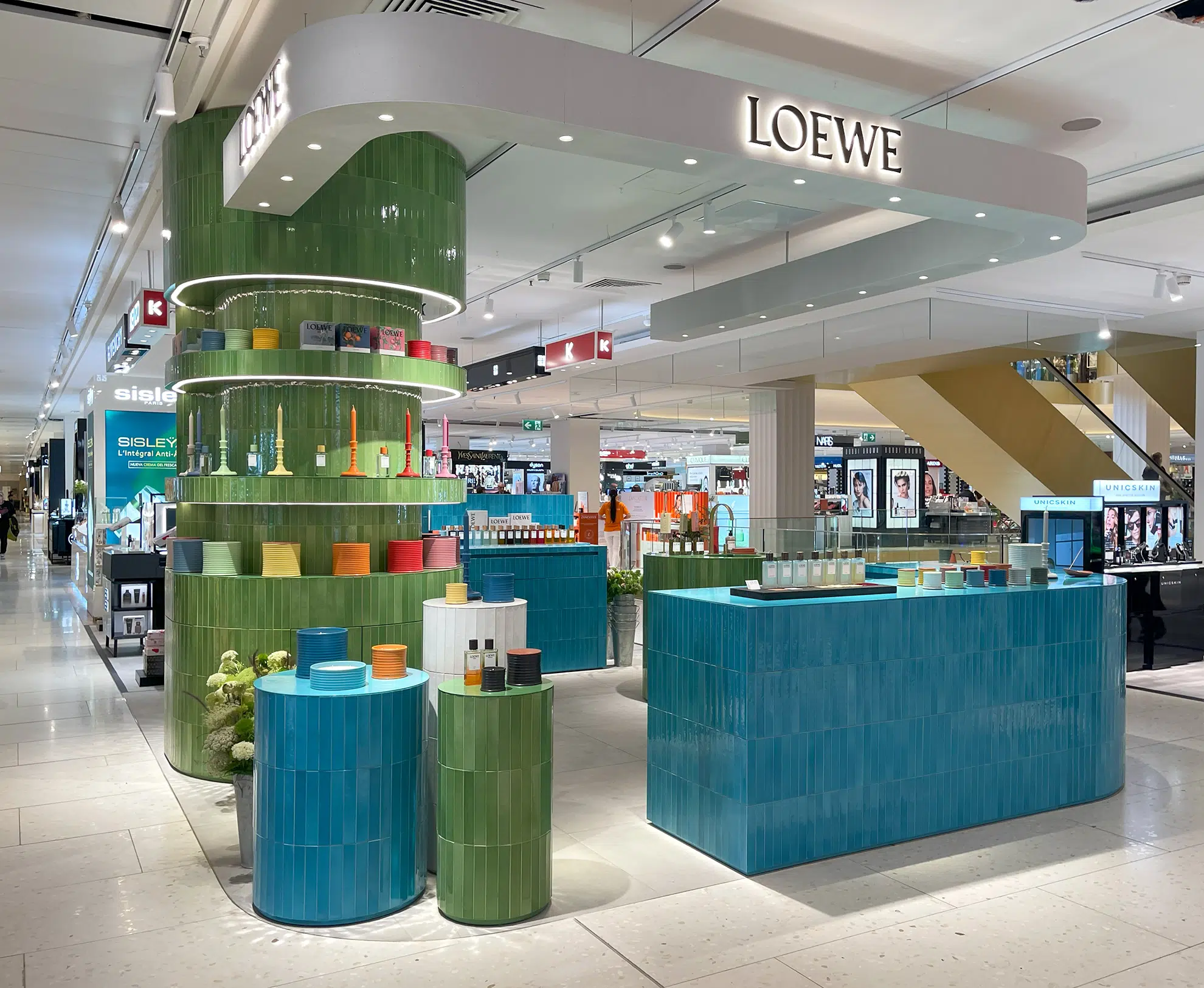
This capacity becomes especially visible when a project demands an exceptional level of detail. In the flagship store of Loewe at El Corte Ingles in Barcelona, Madrid, Seville, and Bilbao, the design incorporated more than 1,000 ceramic tiles handmade and decorated by an artisan supplier. Each piece featured slight variations in size inherent to the manual production process. Aluma3’s role was to select, discard, and place each tile individually to guarantee an impeccable finish, preserving the artisan essence of the concept while ensuring its technical viability.
Projects of this kind demonstrate that customization is not limited to adapting dimensions or finishes: it means managing singular materials with precision and technical judgment.
Sustainability and Efficiency as Part of the Method
Sustainability is not conceived as an added layer on top of the project, but as a direct consequence of control over the production process. It is embedded in Aluma3’s operational structure, and in-house manufacturing is key to applying it in a consistent and meaningful way.
Smart Material Reuse
Internal manufacturing makes it possible to integrate optimization criteria from the very origin of the project. Technical planning, cut optimization, and the use of surplus material are not isolated decisions: they are practices integrated into the daily operations of the workshop.
Similarly, the design of demountable or reusable structures reflects a perspective that considers not only the initial installation, but also future maintenance, adaptation, or evolution. Every resource is managed with a full-cycle view, understanding that furniture forms part of a space that may be transformed over time.
This approach reduces waste and improves material utilization, while optimizing the investment made in each project.
Reducing Transport and Logistics Footprint
Centralizing production also simplifies the logistics chain. Concentrating the process within a single structure reduces intermediaries and movement between suppliers, maintaining direct traceability over the materials used.
The result is a more efficient and controlled model, coherent with the current demands of premium retail. Sustainability ceases to be a parallel discourse and becomes part of the productive logic that underpins every development.
Success Story: Jo Malone – Sustainability Without Sacrificing Elegance
This vision is especially evident in projects where material selection and production process management form part of a conscious strategy. For the refurbishment of the Jo Malone London flagship store in Madrid, laminated metals from recycling processes were incorporated, and internal responsible waste management criteria were applied throughout manufacturing and installation.
Beyond the final material, sustainability was understood as a way of working: planning with sufficient lead time, optimizing resources, and reducing unnecessary impact without compromising the aesthetic quality of the space.
In the in-house workshop, sustainability stops being a discourse and becomes a measurable, scalable, and tangible process.

End-to-End Methodology: From the First Sketch to Maintenance
In-house manufacturing makes full sense within an end-to-end methodology that covers every phase of the project. At Aluma3, retail furniture development is not understood as a succession of independent stages, but as a continuous process in which design, technical development, production, installation, and maintenance form part of a single operational structure.
A Process That Connects Every Phase
Our end-to-end methodology allows the retail project to be approached as a unified process, avoiding fragmentation between design, production, and installation. The project is structured as a continuous process that integrates:
- Strategic design, where needs, flows, and brand positioning are defined.
- Technical development, which translates the concept into viable construction solutions.
- Internal manufacturing, where decisions are realized under direct control.
- Specialist installation, carried out by teams who know every piece from its origin.
- Maintenance and evolution, allowing the space to be adapted without losing coherence.
This integration guarantees continuity at every phase, optimizes resources, and concentrates responsibility within a single working system.
Know-How: The Foundation That Sustains the Model
Behind this methodology lies an accumulated body of knowledge built project by project. Workshop experience does not only enable production: it enables the refinement of processes, the improvement of assembly methods, and the anticipation of adjustments before they become incidents.
When design and manufacturing coexist in the same environment, learning is constant. Every development contributes technical insight that feeds into the next, progressively raising the standard of quality and efficiency. This know-how is not limited to execution: it is present from the first sketch, contributing judgment and feasibility to every decision.
The combination of end-to-end methodology and applied knowledge allows every commercial furniture project to be approached with a holistic vision, where coherence, control, and evolution are part of the same system.
Success Story: Kerastase – Designing So That Every Centimeter Counts
This methodology becomes especially visible in projects where the space requires every technical decision to be rethought. For the Kerastase corner, the challenge was to adapt an international concept designed for approximately 90 m² to a real space of just 40 m², without losing brand identity or experience.
The process began with a strategic analysis of customer flow and product placement, followed by technical development that allowed the original guidelines to be reinterpreted and adapted to the actual dimensions of the point of sale. Internal manufacturing facilitated the creation of specific elements and bespoke solutions that optimized every available centimeter while maintaining the visual and functional coherence of the whole.
Projects of this kind demonstrate that end-to-end methodology is not simply about executing a design: it means understanding it, adapting it, and realizing it with technical judgment. The accumulated know-how allows global concepts to be translated into concrete contexts, ensuring that the final experience responds both to brand requirements and to the real conditions of the space.

The Strategic Value of Unlimited Customization
In-house manufacturing is not simply one more phase within the development of retail furniture: it is the foundation that sustains the entire process. It enables a higher level of control, integrates design and production under a shared set of criteria, and ensures that every project is realized with coherence from the very beginning.
When all phases coexist within a single structure, decisions are made with a holistic view and the brand retains control over its physical expression in the space.
At Aluma3, in-house manufacturing is not simply a production capability. It is the structure that guarantees continuity, precision, and robustness across every project.